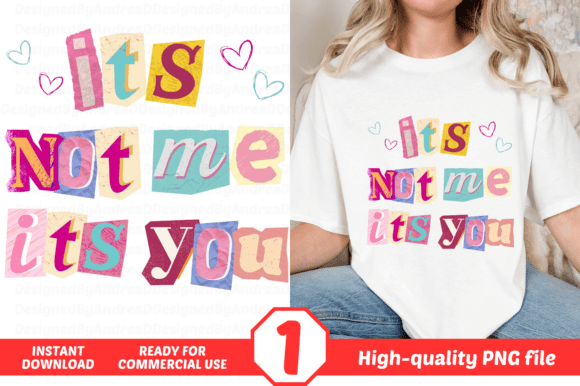
Integrating the "It's Not Me, It's You" Sublimation Design into Professional Creative Workflows
In the fast-paced world of digital design and print-on-demand entrepreneurship, the difference between a hobbyist and a professional often lies in the efficiency of their asset management and the strategic application of their creative resources. One such resource that has gained traction for its versatility and cultural resonance is the "It's Not Me, It's You" sublimation design. While the phrase itself is a staple of pop culture and interpersonal communication, its translation into a high-resolution PNG format opens up a specific set of workflows for creators, marketers, and small business owners. Understanding how to integrate this specific asset into a broader production pipeline requires more than just downloading a file; it demands a clear strategy regarding preparation, compatibility, and end-use application.
The core value of this asset lies in its technical specification: a single PNG file rendered at 300 DPI resolution. For professionals accustomed to managing large libraries of graphics, this specification is not merely a detail but a foundational requirement for quality control. A 300 DPI (dots per inch) resolution ensures that when the design is transferred from a digital screen to a physical substrate—whether it be a ceramic mug, a polyester t-shirt, or a metal ornament—the output remains crisp, legible, and free from pixelation. This level of clarity is non-negotiable for businesses aiming to maintain a reputation for high-quality goods. When planning a project involving this design, the workflow begins with verifying that your working environment respects this resolution, ensuring that no unnecessary downscaling occurs during the import phase.
Strategic Placement in the Production Lifecycle
Integrating the "It's Not Me, It's You" graphic into your operations can happen at various stages of a project, depending on your specific business model. For a print-on-demand entrepreneur, this asset fits naturally into the product development phase. Before committing to a mockup or a sample order, the designer must assess how the typography and layout of the PNG interact with the chosen product template. Because the file is easy to resize with different software, it offers flexibility during this prototyping stage. You can test the design on a standard 11oz mug, a oversized tote bag, or a framed wall art piece without losing fidelity. This adaptability allows for rapid iteration, a key component of agile creative processes.
For educators and content creators, the usage might occur during the content creation phase. The phrase carries a humorous, slightly self-deprecating tone that resonates well with audiences on social media or in blog posts discussing boundaries, relationships, or personal growth. Here, the workflow involves importing the PNG into image editing software to layer it over photography or background textures. The transparency inherent in the PNG format is crucial here, as it allows the text to sit cleanly over complex backgrounds without unsightly white boxes, maintaining a professional aesthetic that aligns with modern design standards.
Compatibility and Software Integration
A significant advantage of this specific download is its universal compatibility. Whether your workflow relies on industry-standard tools like Adobe Photoshop and Illustrator, or more accessible platforms like Canva, Cricut Design Space, or Silhouette Studio, the PNG format acts as a neutral bridge. This interoperability reduces friction in the workflow. You do not need to spend time converting file types or worrying about vector tracing unless you specifically require path editing. The raster nature of the 300 DPI PNG means what you see is largely what you get, provided your canvas settings match the intended print size.
When utilizing sublimation-specific software, the integration process requires attention to color management. Sublimation printing involves transferring dye into materials using heat, which can sometimes shift colors slightly compared to an RGB screen display. Professionals should treat the "It's Not Me, It's You" file as a starting point for color profiling. It is advisable to run a test print on sublimation paper to verify that the blacks are deep enough and that any graphical elements surrounding the text retain their integrity after the heat press cycle. This step of quality assurance is vital before scaling up to bulk production for clients or inventory.
Expanding Business Offerings Through Versatility
The prompt for this asset highlights its utility across a wide spectrum of products: stickers, t-shirts, cards, frame illustrations, scrapbooks, and wall decoration. For a small business owner, this variety suggests a strategy of product diversification rather than singular focus. Instead of limiting the design to one niche, a pragmatic approach involves mapping the asset to multiple revenue streams simultaneously. For instance, the same design session can yield files prepared for a apparel line, a stationery collection, and a home decor series. This maximizes the return on investment for the time spent acquiring and setting up the design file.
Consider the workflow for a seasonal campaign. The phrase "It's Not Me, It's You" often sees spikes in interest around holidays associated with relationships, such as Valentine's Day, or during periods of cultural trends focusing on self-care and boundaries. By having this high-quality asset ready in your library, you can rapidly deploy it across these verticals. You might create a bundle offering that includes a matching t-shirt and a coffee mug, using the consistent branding provided by the identical source file. This consistency reinforces brand identity and simplifies marketing efforts, as the visual language remains uniform across different touchpoints.
Optimization for Long-Term Use
To ensure the longevity and continued utility of this design within your archive, organization is key. Rather than saving the file in a generic "Downloads" folder, integrate it into a structured asset management system. Tag the file with relevant metadata such as "typography," "humor," "relationship," "sublimation," and "300 DPI." This practice ensures that six months or a year down the line, when you are planning a new collection, the file is easily retrievable. Efficient retrieval systems prevent the common pitfall of repurchasing assets or wasting time searching for files that are already owned.
Furthermore, consider the scalability of the design. While the provided PNG is high resolution, there may be instances where you need to manipulate the text or alter the composition for a specific client request. If your workflow permits, keeping a record of the source or understanding the limitations of editing a raster PNG versus a vector SVG is important. For most standard applications described—stickers, shirts, frames—the 300 DPI PNG is sufficient. However, if a client requests a massive billboard-sized adaptation, you may need to communicate the limitations of the current file or explore upscaling techniques that preserve edge sharpness.
Practical Implementation Tips for Creators
When moving from digital file to physical product, the preparation of the substrate is just as important as the quality of the design. For sublimation on t-shirts, ensure the polyester content is high enough to accept the dye vividly; for mugs, ensure the coating is fresh and free of oils. The "It's Not Me, It's You" text relies on readability, so any distortion caused by poor substrate preparation will undermine the design's impact. Always perform a "dry run" or a mental walkthrough of the pressing process: alignment, temperature, pressure, and time. These variables interact directly with the ink density of your printed PNG.
Additionally, leverage the exclusivity mentioned in the offer to build a unique brand voice. If these designs are exclusive, they offer a competitive edge. Use this to your advantage in marketing copy. Highlighting that your products feature unique, non-generic artwork can justify premium pricing and attract customers looking for distinctiveness in a saturated market. The narrative around the product becomes part of the value proposition.
In conclusion, the "It's Not Me, It's You" PNG sublimation design is more than just a graphic; it is a flexible tool that, when managed correctly, enhances productivity and expands creative possibilities. By respecting the technical specifications, integrating the file smoothly into diverse software ecosystems, and applying it strategically across various product lines, professionals can extract maximum value from this asset. The key lies in treating the download not as an endpoint, but as a component in a larger, well-oiled machine of creation and commerce. Whether you are a freelancer managing a single client project or an entrepreneur building a catalog, the disciplined application of such resources drives consistent, high-quality outcomes.